
文字のない物語はどこからきたのか 山本美希研究室 Where did the wordless stories come from? Miki Yamamoto Lab.
文字のない物語はどこからきたのか
Where did the wordless stories come from?
山本美希研究室
Miki Yamamoto Lab.
2026年2⽉3⽇ (⽕)〜3⽉26⽇(⽊)
9:00~17:00(土日祝休館)
筑波大学 大学会館アートスペース
〒305-8574 茨城県つくば市天王台1-1-1
つくばエクスプレス「つくば駅」からバス約10分「大学会館前」下車
入場無料
文字のない物語(Wordless Stories)や文字のない絵本(Wordless Picturebooks)と呼ばれる分野については、これまで20世紀後半に始まった新しい分野だと捉えられ、その成立や発展の過程についてはほとんどわかっていませんでした。しかし、実際にはそれ以前の作品もさまざま作られており、またヨーロッパが中心ではあるものの、日本や中国など、アジアでも作例を見つけることができます。本展示では、19世紀から20世紀中頃までの文字のない絵本を展示し、その歴史の一端を紹介します。
The field known as Wordless Stories and Wordless Picturebooks has generally been regarded as a new genre that began in the latter half of the 20th century, with little understanding of its origins and development. However, various works existed before that time, and although Europe remains the main center, examples can also be found in Asia, including Japan and China. This exhibition features wordless picturebooks from the 19th century to the mid-20th century, introducing a part of their history.
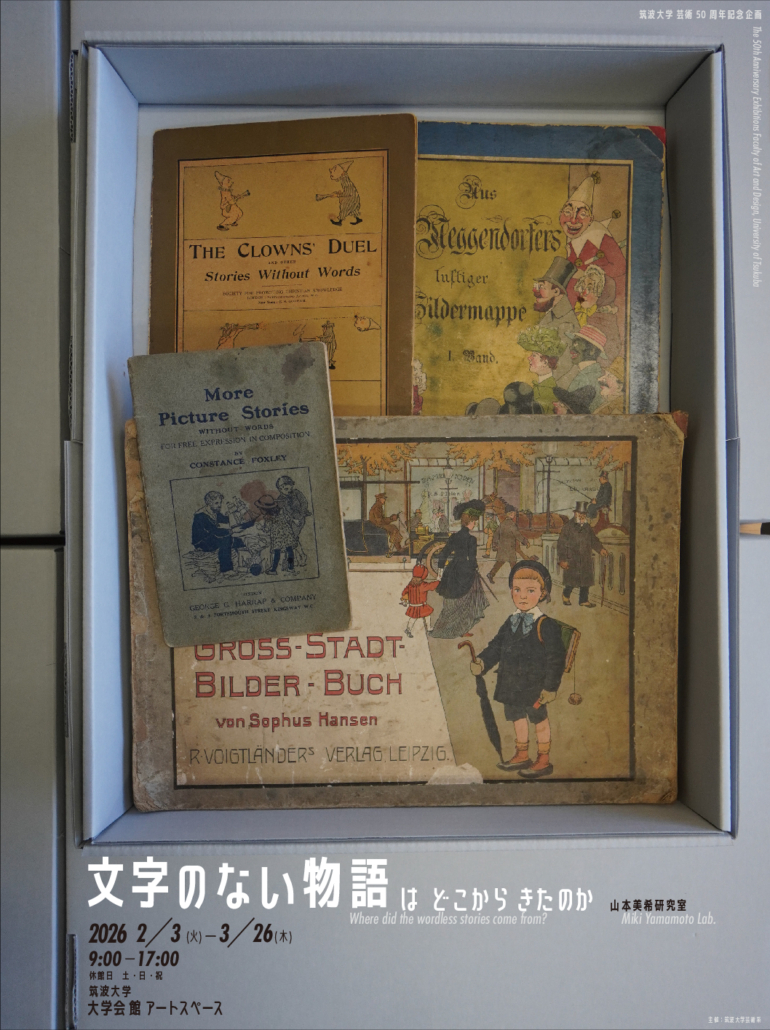
チラシに使用した本
Raymond de La Nézière, et al., The Clowns’ Duel and Other Stories Without Words, London: Society for Promoting Christian Knowledge, 1905.
Lothar Meggendorfer, Aus Lothar Meggendorfers lustiger Bildermappe Band. 1., Stuttgart: J. F. Schreiber, 1888.
Constance Foxley, More Picture Stories Without Words, London: Harrap, 1916.
Sophus Hansen, Gross-Stadt-Bilder-Buch, Leipzig: R. Voigtländer, 1909.
JSPS科研費(23K23058)「文字のない物語表現の歴史と発展・変遷を追う分野横断的研究」関連事業